
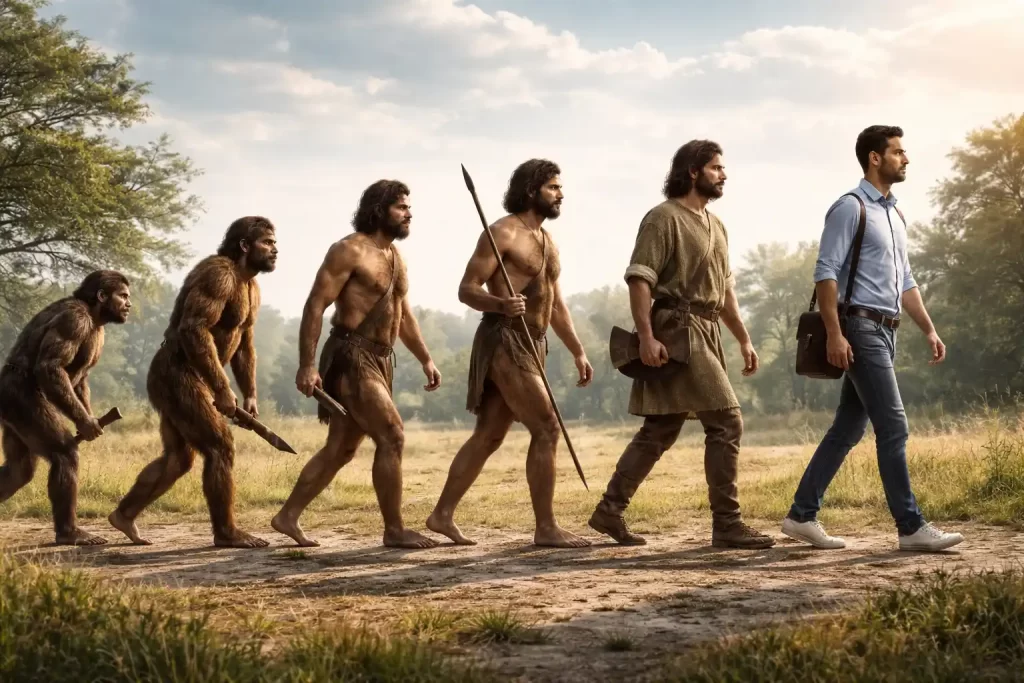
1) Vocabulário Base
Leia as palavras ou expressões abaixo para ampliar seu vocabulário.
| Termo | Pronúncia | Tradução | Exemplo |
|---|---|---|---|
| humankind | riú-mén-káind | humanidade | Humankind changed the planet. |
| evolution | é-vo-lú-shan | evolução | Evolution takes time. |
| hunter-gatherer | rân-ter gá-der-er | caçador-coletor | Humans were hunter-gatherers. |
| agriculture | á-gri-kâl-tcher | agricultura | Agriculture changed society. |
| empire | ém-páier | império | Empires ruled many lands. |
| belief | bi-líif | crença | Beliefs unite people. |
| religion | ri-lí-djan | religião | Religion shaped cultures. |
| money | mâ-ni | dinheiro | Money is a shared idea. |
| science | sái-ens | ciência | Science seeks knowledge. |
| progress | pró-gres | progresso | Progress brings change. |
2) Prática Assistida
Agora leia o texto abaixo em voz alta da maneira que conseguir, o professor irá corrigir as pronúncias necessárias.
Yuval Noah Harari is a historian and professor.
He wrote the book Sapiens: A Brief History of Humankind.
The book tells the story of humans.
It starts thousands of years ago.
It ends in the modern world.
The book asks big questions.
Who are we?
How did we get here?
Why do we live like this today?
The answers are surprising and simple.
Harari explains that humans are animals.
We are part of nature.
We are not special by birth.
We became powerful over time.
This power came from our minds.
The story begins with early humans.
They lived as hunter-gatherers.
They hunted animals.
They collected fruits and plants.
They lived in small groups.
These early humans moved a lot.
They followed food.
They knew nature very well.
They worked only a few hours a day.
Their lives were simple, but not easy.
Harari says humans were happy sometimes.
But life was dangerous.
Animals were strong.
Nature was harsh.
Death was common.
Then came a big change.
This change is called the Cognitive Revolution.
It happened about 70,000 years ago.
Humans started to think differently.
They started to imagine things.
Humans created stories.
They created myths.
They created beliefs.
These things are not physical.
But they are very powerful.
Because of stories, humans could cooperate.
They could work in large groups.
They trusted strangers.
This was new in nature.
This made humans very strong.
Harari explains shared beliefs.
Money is a shared belief.
Nations are shared beliefs.
Companies are shared beliefs.
They exist because we believe in them.
The next big change was agriculture.
This is called the Agricultural Revolution.
Humans started to farm plants.
They domesticated animals.
They stopped moving so much.
Agriculture gave more food.
But it also brought problems.
People worked more hours.
They ate less variety.
Life became harder for many.
Harari calls this a “trap.”
People thought life was better.
But individuals suffered more.
Population grew fast.
There was no return to old life.
With agriculture came cities.
With cities came kingdoms.
With kingdoms came empires.
Empires ruled many people.
They spread culture and laws.
Harari does not say empires are good or bad.
He says they shaped the world.
They connected people.
They destroyed cultures.
They also created order.
Religion also played a big role.
Religion gave meaning to life.
It explained rules.
It united people.
It justified power.
Harari talks about different religions.
He explains polytheism.
He explains monotheism.
He explains humanism.
All are systems of belief.
The book then talks about money.
Money is not paper or metal.
Money is trust.
People believe money has value.
This belief connects the world.
Trade connected continents.
People shared goods.
People shared ideas.
Money made cooperation easy.
It made global systems possible.
The next big change is science.
This is called the Scientific Revolution.
It started about 500 years ago.
Humans admitted they did not know everything.
This changed history.
Science is based on curiosity.
It is based on observation.
It looks for evidence.
It changes ideas when needed.
It leads to progress.
Science joined with money and power.
Governments paid for research.
Research gave new tools.
Tools gave more power.
Power changed the world.
Harari talks about progress.
He asks if humans are happier.
We have more comfort.
We have more technology.
But happiness is not clear.
Modern humans live longer.
We have medicine.
We have machines.
We have information.
But we also have stress.
The book talks about suffering.
Animals suffer in farms.
Nature suffers from pollution.
Humans change the planet fast.
This brings responsibility.
At the end, Harari talks about the future.
He talks about biotechnology.
He talks about artificial intelligence.
Humans may change themselves.
This is a new chapter.
He asks hard questions.
What do we want to become?
What is happiness?
What is a good life?
Science cannot answer all.
The main message is reflection.
Humans are powerful.
But power needs wisdom.
We must understand our past.
This helps us choose the future.
Sapiens is not just history.
It is a mirror.
It shows who we are.
It asks us to think.
It invites responsibility.
3) Compreensão Ativa
Responda as perguntas abaixo para praticar a compreensão.
- O que você entendeu de um modo geral sobre o texto?
- Agora releia o texto e fale para o professor todas as palavras ou expressões que você não conhece ou não entendeu o significado corretamente.
- Como viviam os primeiros humanos segundo o texto?
- O que foi a Revolução Cognitiva?
- Por que histórias e crenças são importantes para os humanos?
- Qual foi o impacto da agricultura na vida das pessoas?
- Qual é o papel da religião na história humana?
- Por que o dinheiro é considerado uma crença compartilhada?
- O que mudou com a Revolução Científica?
- Qual pergunta principal o autor faz sobre o progresso?
4) Conversação Aplicada
Now, let’s talk in English about what you read. Try to answer even with simple words — the goal is to speak!
- What part of human history surprised you the most?
- Do you think life was better before or now? Why?
- What shared beliefs are important in your life?
- How do stories help people work together?
- Do you think technology makes people happier?
- What is one problem humans created today?
- How can humans protect the planet better?
- What does progress mean to you?
- What do you think about the future of humans?
- What lesson can we learn from the past?
Parabéns! Você praticou inglês com um dos livros mais importantes sobre a história da humanidade. Aprendeu vocabulário real, treinou leitura e falou sobre ideias profundas de forma simples e prática.
Agora é com você! Agende sua próxima aula com a Fluência Rápida e continue evoluindo no inglês — passo a passo, com clareza, confiança e sem desistir no meio do caminho. 🚀