
1) Vocabulário Base
Leia as palavras ou expressões abaixo para ampliar seu vocabulário.
| Termo | Pronúncia | Tradução | Exemplo |
|---|---|---|---|
| Culture | KÂL-tcher | Cultura | Japanese culture is very interesting. |
| Respect | ri-SPEKT | Respeito | Respect is very important in Japan. |
| Quiet | KUAI-et | Silencioso | The subway is very quiet. |
| Queue | KIU | Fila organizada | People wait in a queue. |
| Clean | KLIN | Limpo | The streets are very clean. |
| Rule | RUL | Regra | There is a rule about noise. |
| Temple | TEM-pel | Templo | The temple is peaceful. |
| Technology | tek-NÓ-lo-dji | Tecnologia | Japan is famous for technology. |
| Convenience store | kon-VI-ni-ens stor | Loja de conveniência | The convenience store is open 24 hours. |
| Tradition | tra-DI-shon | Tradição | Tradition is important in Japan. |
2) Prática Assistida
Agora leia o texto abaixo em voz alta da maneira que conseguir, o professor irá corrigir as pronúncias necessárias.
Tokyo is the capital of Japan.
It is one of the largest cities in the world.
For many tourists, Tokyo is exciting and surprising.
The city mixes tradition and modern technology.
This mix creates strong cultural shocks.
One of the first surprises is silence.
Public transportation is very quiet.
On the subway, people do not talk loudly.
Many passengers use their phones silently.
Phone calls are not common inside trains.
This shows respect for others.
Respect is a key part of Japanese culture.
People bow when they greet each other.
Bowing is a traditional way to say hello or thank you.
Another surprise is organization.
People wait in a perfect queue for trains.
They stand in lines marked on the floor.
Nobody pushes or tries to skip the line.
Even in crowded stations, everything is calm.
Cleanliness is also impressive.
The streets are very clean.
You rarely see trash on the ground.
However, there are not many trash cans.
People carry their trash home.
This sense of responsibility is cultural.
Convenience stores are everywhere.
They are open 24 hours a day.
You can buy fresh food, drinks, and daily products.
The quality of food is surprisingly good.
Technology is another strong impression.
There are vending machines on many streets.
Some machines sell drinks, others sell hot meals.
Toilets are also high-tech.
They have heated seats and many buttons.
For many tourists, this is funny and surprising.
Tokyo is also famous for its contrast.
You can visit ancient temples in the morning.
In the afternoon, you can explore modern districts.
Asakusa is known for traditional temples.
Senso-ji Temple is very popular.
Visitors walk through a historic street with small shops.
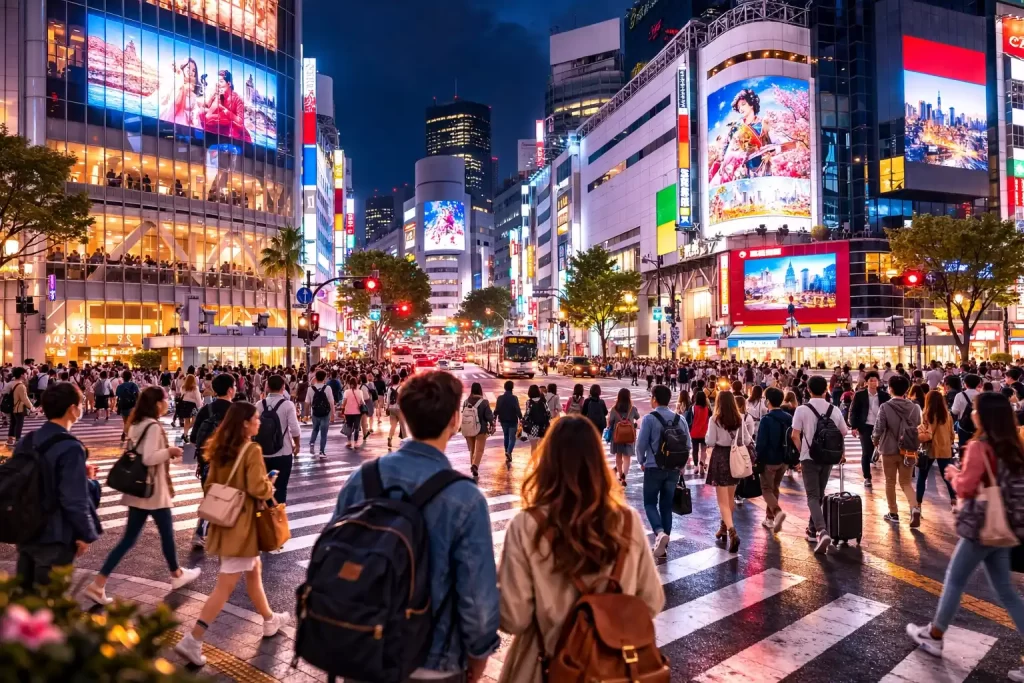
On the other side, Shibuya is modern and energetic.
Shibuya Crossing is one of the busiest crossings in the world.
When the light turns green, hundreds of people cross at the same time.
It looks chaotic, but it is organized.
Another cultural shock is food etiquette.
In Japan, you can make noise when eating noodles.
This shows that you enjoy the meal.
But eating while walking is not common.
People usually eat in specific areas.
Tipping is not part of Japanese culture.
In restaurants, service is included in the price.
If you leave extra money, staff may return it.
Personal space is different too.
Tokyo is very crowded.
Trains can be full during rush hour.
Yet people respect each other’s space.
They avoid eye contact.
They try not to disturb others.
Another surprise is safety.
Tokyo is considered very safe.
People often leave phones or bags on tables.
Crime rates are low.
This creates a feeling of security.
Time management is very strict.
Trains arrive exactly on time.
Even a one-minute delay is unusual.
Punctuality is very important.
Fashion in Tokyo can also surprise tourists.
In areas like Harajuku, people wear creative and colorful clothes.
Young people express their identity through style.
At the same time, business districts are formal and conservative.
This contrast shows different sides of the city.
Nature also exists inside Tokyo.
There are parks and quiet gardens.
Meiji Shrine is surrounded by trees.
It feels peaceful and spiritual.
Tourists often feel overwhelmed at first.
The city is big and fast.
Signs may be in Japanese.
But many signs also include English.
Public transportation is efficient and easy to use.
After a few days, visitors feel more comfortable.
They start to understand the rules.
They learn to bow slightly.
They speak more softly on the train.
They follow the queue naturally.
Tokyo teaches respect and organization.
It shows how tradition and technology can live together.
The cultural shock is strong, but positive.
Tourists often leave impressed.
They admire the discipline and kindness of people.
Tokyo may feel different from Western cities.
But that difference makes it special.
Traveling to Tokyo is not only a trip.
It is a learning experience.
It changes how you see culture and daily life.
And for many tourists, it becomes one of the most unforgettable destinations in the world.
3) Compreensão Ativa
Responda as perguntas abaixo para praticar a compreensão:
- O que você entendeu de um modo geral sobre o texto?
- Por que o silêncio no transporte público surpreende turistas?
- O que as pessoas fazem com o lixo nas ruas?
- O que é considerado educado ao comer noodles no Japão?
- Por que deixar gorjeta pode causar estranhamento?
- O que acontece quando o sinal abre no Shibuya Crossing?
- Como é a pontualidade dos trens em Tóquio?
- O que diferencia Asakusa de Shibuya?
- Por que Tóquio é considerada uma cidade segura?
- Segundo o texto, por que o choque cultural em Tóquio é positivo?
4) Conversação Aplicada
Now, let’s talk in English about what you read. Try to answer even with simple words — the goal is to speak!
- What cultural shock surprised you the most?
- Do you think silence in public transport is positive?
- Would you feel comfortable bowing instead of shaking hands?
- How do people behave in queues in your country?
- Would you like to visit a traditional temple?
- How do you feel about high-tech toilets?
- Is punctuality important in your daily life?
- Do you like big and busy cities?
- Would you follow Japanese food etiquette?
- Would you like to visit Tokyo? Why?
Parabéns! Você acabou de explorar um choque cultural real e praticou inglês com vocabulário atual e útil. Isso é evolução de verdade!
Continue avançando com curiosidade e confiança. Agende sua próxima aula com a Fluência Rápida e transforme cada cultura nova em mais fluência, mais segurança e mais naturalidade no seu inglês! 🇯🇵✨