
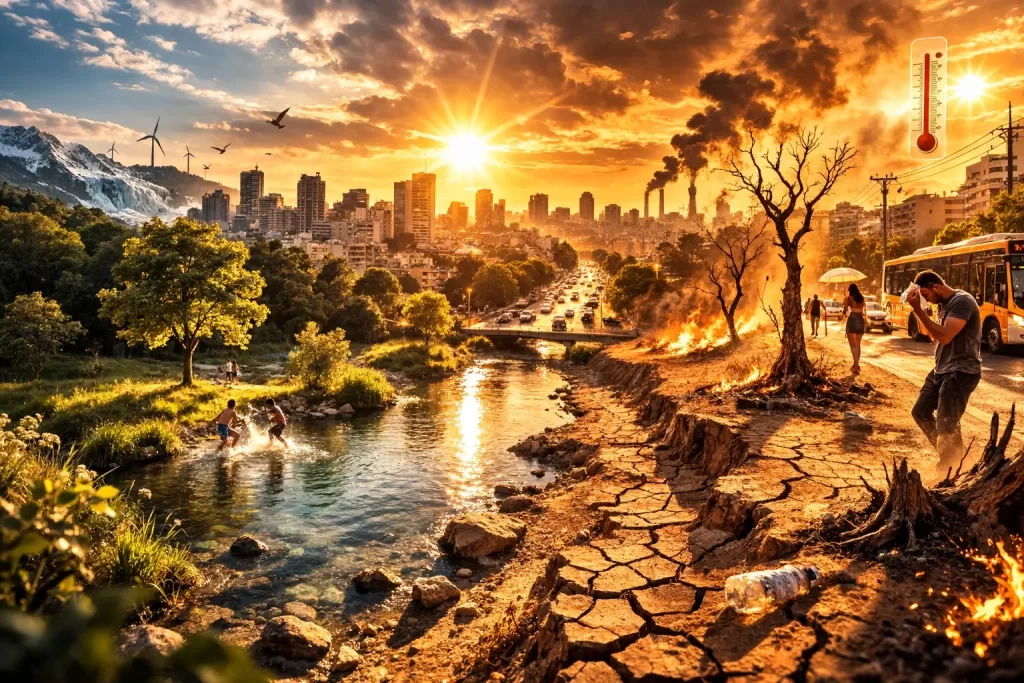
1) Vocabulário Base
Leia as palavras ou expressões abaixo para ampliar seu vocabulário.
| Termo | Pronúncia | Tradução | Exemplo |
|---|---|---|---|
| Climate | KLAI-met | Clima | The climate is changing. |
| Temperature | TEM-pra-tchur | Temperatura | The temperature is higher today. |
| Heatwave | RIT-weiv | Onda de calor | The city had a heatwave last summer. |
| Flood | FLÂD | Enchente | The flood damaged many houses. |
| Drought | DRAUT | Seca | The drought affected farmers. |
| Pollution | po-LU-shon | Poluição | Pollution harms the environment. |
| Emissions | i-MI-shons | Emissões | Car emissions increase pollution. |
| Renewable energy | ri-NU-a-bel EN-er-dji | Energia renovável | Solar power is renewable energy. |
| Environment | in-VAI-ron-ment | Meio ambiente | We must protect the environment. |
| Impact | IM-pakt | Impacto | Climate change has a strong impact. |
2) Prática Assistida
Agora leia o texto abaixo em voz alta da maneira que conseguir, o professor irá corrigir as pronúncias necessárias.
Global warming is one of the biggest challenges today.
It refers to the increase in Earth’s temperature.
This change affects the global climate.
Scientists have observed this process for many years.
The main cause is the increase in greenhouse gas emissions.
Burning fossil fuels produces carbon dioxide.
Cars, factories, and power plants release gases into the air.
Deforestation also increases emissions.
Trees absorb carbon dioxide.
When forests disappear, this balance is broken.
The impact of global warming is already visible.
Temperatures are rising in many regions.
Heatwaves are becoming more frequent.
Some cities experience extreme heat during summer.
This affects health, especially for elderly people.
Air conditioning use increases.
Electricity consumption becomes higher.
Water resources are also affected.
Some regions suffer from drought.
Farmers face difficulties growing crops.
Food production becomes unstable.
In other areas, floods are more common.
Heavy rain damages houses and roads.
Communities need to rebuild after storms.
Extreme weather events are stronger today.
Hurricanes and storms cause destruction.
Insurance costs increase.
Governments invest more in emergency services.
Global warming also affects oceans.
Sea levels are rising slowly.
Ice in polar regions is melting.
Coastal cities face risk of flooding.
Some small islands are in danger.
Marine life is also impacted.
Coral reefs suffer from higher water temperatures.
Biodiversity decreases in some ecosystems.
Health is another concern.
Heat increases the risk of dehydration.
Air pollution can worsen respiratory problems.
Mosquito-borne diseases may spread more easily in warmer climates.
Daily life is changing too.
People adjust routines because of extreme weather.
Outdoor activities may be limited during heatwaves.
Travel plans change due to storms or wildfires.
Insurance and food prices can rise.
Global warming also influences the economy.
Agriculture, tourism, and fishing are affected.
Some regions depend heavily on natural resources.
When climate changes, jobs may disappear.
However, there are positive changes as well.
Awareness about the environment is increasing.
More people talk about sustainability.
Companies invest in renewable energy.
Solar and wind energy are expanding.
Electric cars are becoming more common.
Governments create environmental policies.
Recycling and waste reduction are encouraged.
Individuals also take action.
Some people reduce plastic use.
Others choose public transportation.
Small daily habits make a difference.
Education about climate is more present in schools.
Young people participate in environmental movements.
Technology helps monitor climate patterns.
Scientists use data to predict weather changes.
This information helps communities prepare.
Adaptation is necessary.
Cities build better drainage systems.
Some countries develop heat action plans.
Urban areas create more green spaces.
Trees help reduce temperature in cities.
Global warming is a complex issue.
It affects nature and society.
The impact is not equal everywhere.
Some regions suffer more than others.
Poor communities are often more vulnerable.
International cooperation is important.
Countries need to work together.
Reducing emissions is a global responsibility.
The future depends on current decisions.
Climate change is not only about polar bears.
It affects food, water, health, and economy.
It influences our daily lives.
Understanding the problem is the first step.
Taking action is the next step.
Small changes can create collective impact.
Global warming is already changing our world.
But solutions also exist.
With awareness, innovation, and cooperation, change is possible.
The climate is changing.
But human action can also create positive change.
The question is not if it affects us.
The question is how we respond.
3) Compreensão Ativa
Responda as perguntas abaixo para praticar a compreensão:
- O que você entendeu de um modo geral sobre o texto?
- Qual é a principal causa do aquecimento global mencionada no texto?
- Como as ondas de calor afetam a vida das pessoas?
- De que forma o aumento do nível do mar impacta cidades costeiras?
- Por que a agricultura é afetada pelas mudanças climáticas?
- Quais são dois exemplos de eventos climáticos extremos citados?
- Como a energia renovável ajuda a enfrentar o problema?
- Por que comunidades pobres são mais vulneráveis?
- Que mudanças no cotidiano as pessoas já estão fazendo?
- Segundo o texto, qual é o próximo passo depois de entender o problema?
4) Conversação Aplicada
Now, let’s talk in English about what you read. Try to answer even with simple words — the goal is to speak!
- Do you think climate change affects your country? How?
- Have you experienced extreme heat or heavy rain?
- Do you try to reduce pollution in your daily life?
- What renewable energy do you know?
- Do you think electric cars are the future?
- How can schools teach more about the environment?
- Do you recycle at home?
- What small habit could you change to help the planet?
- Do you think governments are doing enough?
- What does a sustainable life mean to you?
Parabéns! Você discutiu um tema global e atual enquanto praticava inglês com consciência e vocabulário útil. Isso é evolução com propósito!
Continue aprendendo e evoluindo. Agende sua próxima aula com a Fluência Rápida e transforme informação em confiança, consciência e fluência no seu inglês! 🌍✨